

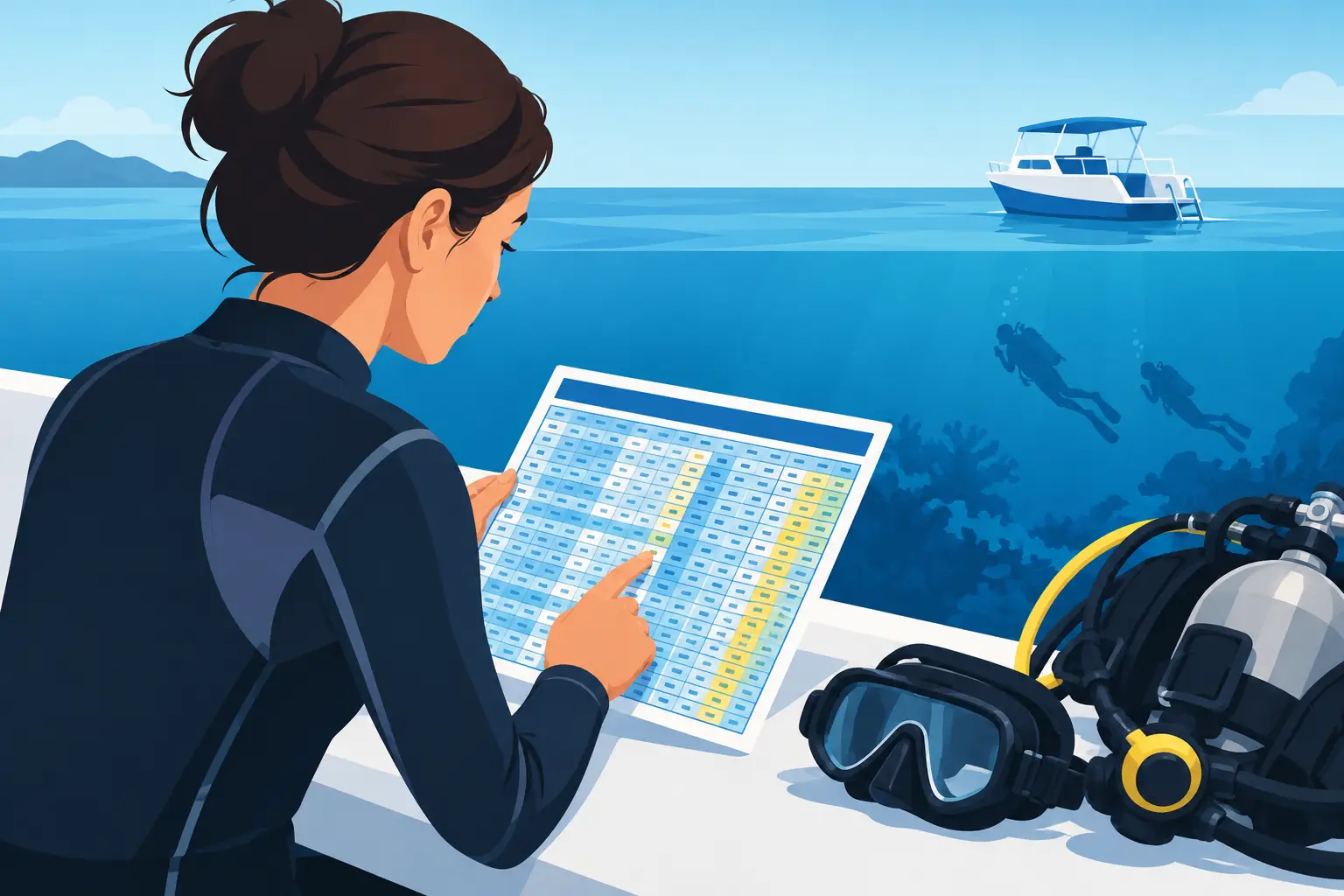
A calm descent over a bright reef is not the moment to wonder whether yesterday’s dive still affects today’s plan. Knowing how to read dive tables gives you a clearer view of your nitrogen exposure before you enter the water – a useful foundation whether you are training for certification or enjoying a carefully planned island escape.
Dive tables can look intimidating at first: rows of numbers, depth bands, letters and time limits. Yet they follow a straightforward purpose. They help divers plan no-decompression dives by estimating how much nitrogen the body absorbs at depth and how much time is needed at the surface before a further dive.
What dive tables are designed to tell you
As you descend, pressure increases and your body takes on more nitrogen from the air you breathe. The deeper you go and the longer you remain there, the greater that nitrogen loading becomes. Ascend too quickly or exceed a safe exposure limit, and nitrogen can form bubbles in the body, creating a risk of decompression illness.
Traditional recreational dive tables convert that physiology into practical planning information. They tell you the maximum no-decompression time for a chosen depth, assign a pressure group after the dive, and show how a surface interval reduces that group before the next descent.
They are not a licence to push limits. Tables are deliberately conservative, but they cannot account perfectly for every person, every dive profile or every condition. Cold water, demanding swimming, dehydration, fatigue, illness and repetitive dives can all influence the margin you should leave. For most holiday diving, the best plan is comfortably within the limit, not precisely at it.
How to read dive tables: the essential sequence
Different organisations publish different tables, so always use the version taught in your course and follow its specific instructions. The layout varies, but the planning sequence remains similar.
1. Round depth up, never down
Begin with your planned maximum depth. If a reef slopes from 16 metres to 18 metres and your table lists 15-metre and 18-metre rows, use 18 metres. If your deepest point is 19 metres and the next available depth is 21 metres, plan with 21 metres.
This is one of the most valuable habits in dive planning. Your computer records the actual profile, but a table works in depth bands. Rounding up creates a more cautious plan and prevents an optimistic interpretation of a changing underwater route.
2. Find the no-decompression limit
Read across the selected depth row to find the no-decompression limit, often abbreviated to NDL. This is the maximum allowable bottom time at that depth without mandatory decompression stops under the table’s assumptions.
Bottom time is generally measured from the start of descent until the start of the final ascent. Your training agency will define this precisely for its table, so use that definition rather than guessing. If you plan a 25-minute dive at 18 metres, confirm that 25 minutes sits within the applicable NDL. If it does not, shorten the dive, choose a shallower profile or use a different plan under professional guidance.
A table may show a time bracket rather than your exact planned time. Always select the next longer time. For example, if your bottom time is 26 minutes and the table offers 25 and 30 minutes, use 30 minutes. Rounding down is not safe planning.
3. Identify your pressure group
At the intersection of your depth and rounded-up bottom time, the table provides a letter, commonly called a pressure group or repetitive group. Think of it as a simplified snapshot of residual nitrogen after the dive.
The letter itself is not a judgement of whether the dive was good or bad. It becomes useful when planning another dive later in the day. A longer or deeper dive usually results in a later letter in the alphabet, indicating more residual nitrogen under the table’s model.
4. Credit the surface interval
After surfacing, find the table section for surface intervals. Locate your ending pressure group, then identify the time you will spend out of the water before your next descent. Tables normally give a range of times and the new, reduced pressure group you reach after that interval.
Be exact about when the interval begins and ends. It starts when you surface from the first dive and ends when you begin descending for the next. Lunch on the beach, a relaxed boat journey or a quiet hour by the pool all count as surface time, but only the actual elapsed time matters.
5. Add residual nitrogen time for the next dive
For a repetitive dive, select the planned maximum depth for dive two and use your new pressure group to find residual nitrogen time, often called RNT. This is the table’s way of carrying nitrogen exposure from the first dive into the second.
Add RNT to the actual bottom time you want for the next dive. The result is total nitrogen time, or TNT. Use that total to establish the pressure group at the end of the second dive. The planned dive must remain within the no-decompression limit at its chosen depth.
For instance, imagine your second dive is planned for 15 metres with 35 minutes of actual bottom time. If the table assigns 12 minutes of residual nitrogen time for your pressure group, you plan against 47 minutes, not 35. The arithmetic is simple; choosing the correct row and rounding conservatively are the parts that demand care.
A practical planning example
Suppose you make a morning dive to a maximum of 18 metres. Your actual bottom time is 32 minutes. On a standard table that groups times into brackets, you would choose the 18-metre row and round 32 minutes up to the next listed time. The corresponding letter is your ending pressure group.
After a 90-minute surface interval, use the surface-interval section to find your revised group. For an afternoon reef dive to 15 metres, check the repetitive-dive table at 15 metres and your new letter group. It will give a residual nitrogen time. Add that figure to the 40 minutes you hope to spend exploring, then confirm the combined total remains permitted.
This is only an illustration, not a dive plan. The numbers differ between table models, and your dive professional may set a more conservative schedule based on weather, current, group experience and the day’s itinerary.
Dive tables and computers: use both with good judgement
Modern dive computers continuously track depth and time, which makes them better suited to the multi-level profiles common on scenic reef dives. They can also alert you to ascent-rate issues, safety stops and changing no-decompression time as the dive unfolds. For recreational divers, a properly used computer is usually the primary planning and monitoring tool.
That does not make tables irrelevant. Learning them builds an understanding of why a deeper first dive and a shallower second dive is a sensible order. It also prepares you to think independently about surface intervals and conservative limits if a computer is unavailable or fails.
Do not attempt to combine table calculations with a computer’s no-decompression information to gain extra bottom time. Choose one planning method as instructed by your dive professional, follow the most conservative limit, and make sure every buddy follows the same plan. If two computers disagree, end the dive based on the more conservative reading.
Habits that make your plan safer
The most dependable divers plan for the conditions rather than the ideal photograph. Agree the maximum depth, planned bottom time, turn pressure and ascent procedure with your buddy before entering the water. Stay with the group, monitor your air supply frequently and begin the ascent with plenty in reserve.
A three-minute safety stop near 5 metres is good practice on recreational no-decompression dives, unless your instructor or computer directs otherwise. Ascend slowly, remain well hydrated and leave generous time before flying after diving. Your certification materials and dive centre will provide the appropriate guidance for your dive schedule.
Avoid diving when you feel unwell, severely tired or dehydrated. If a plan feels rushed, conditions become challenging or you simply lose confidence, shorten the dive. A coral garden will still be there tomorrow; your wellbeing is the priority.
Learn tables with an instructor, then enjoy the reef
Reading dive tables is a skill best learnt during formal training, with examples checked by a qualified instructor. At The One Tenggol Island Resort, divers can pair structured SSI training and refresher sessions with the pleasure of exploring clear tropical waters at an unhurried pace.
Once the numbers make sense, they fade into the background where they belong. You can descend with a considered plan, settle into your breathing and give your attention to the colour, movement and quiet wonder of the reef.