

A school of fusiliers flashes across the reef wall, your camera is ready, and the temptation is to stay a little longer. That is where the nitrox versus air decision becomes real. It is not about choosing the ‘better’ gas for every dive. It is about choosing the breathing mix that matches your depth, your dive plan, your certification and the kind of island holiday you want to enjoy.
For many guests, standard air is the familiar, straightforward choice. For certified divers planning several reef dives over consecutive days, nitrox can offer valuable extra time within no-decompression limits. Both can deliver extraordinary encounters in Tenggol’s underwater wonderland. The right choice starts with understanding what changes – and what does not.
Nitrox versus air: what is the difference?
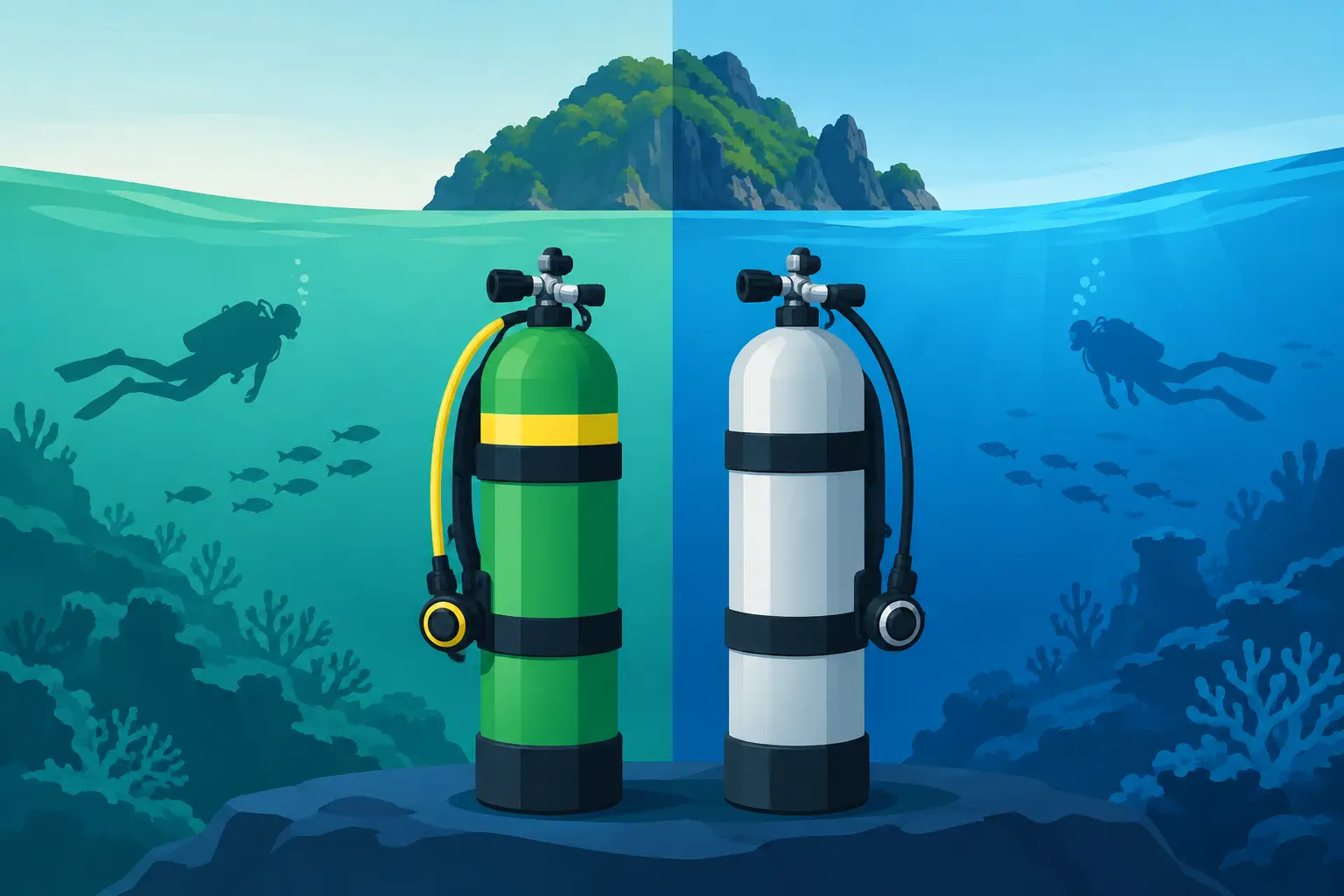
Compressed air for recreational scuba diving contains roughly 21 per cent oxygen and 79 per cent nitrogen, alongside trace gases. Enriched air nitrox, usually shortened to nitrox or EANx, contains more oxygen and therefore less nitrogen than air. Common recreational blends include 32 per cent and 36 per cent oxygen.
That reduced nitrogen fraction is the reason divers use nitrox. During a dive, nitrogen dissolves into the body’s tissues under pressure. The deeper you go and the longer you stay, the more nitrogen your body absorbs. On a comparable dive profile, breathing nitrox generally means taking on less nitrogen than breathing air.
Nitrox does not make a diver immune to decompression sickness, remove the need for a safety stop, or turn a deeper dive into a longer one. It is a planning tool, not a shortcut. Every dive still needs conservative decision-making, a suitable computer setting and close attention to depth, time and ascent rate.
Why nitrox can suit a multi-dive island holiday
The main attraction of nitrox is longer no-decompression limits at moderate depths. If your dive computer is set to the correct oxygen percentage, it calculates your nitrogen exposure using that blend. This may give you more available bottom time than air at the same depth.
That can be especially appealing on a diving-focused escape with several days of exploration. Rather than watching a thriving coral garden from the boat because your no-decompression limit is approaching, a suitable nitrox blend may allow a more relaxed profile. It can be useful for repeat dives on reef slopes, colourful pinnacles and marine-life-rich sites where the best moments often arrive after you have settled into the rhythm of the dive.
Some divers also report feeling less tired after a series of nitrox dives. The science does not establish nitrox as a cure for post-dive fatigue, and a good night’s sleep, hydration, sensible dive profiles and avoiding alcohol matter far more. Still, reducing nitrogen loading can make nitrox an attractive option for divers who want to manage repetitive diving conservatively.
There is another practical advantage. A diver using nitrox may finish a dive with a larger no-decompression margin than they would on air, even if they choose not to extend their bottom time. For a holiday centred on unhurried enjoyment, that margin can support a more conservative approach.
The trade-off: nitrox has a shallower maximum depth
More oxygen is not automatically better. At depth, oxygen partial pressure rises, and excessive exposure can cause oxygen toxicity. This is why each nitrox blend has a maximum operating depth, often called MOD. The higher the oxygen percentage, the shallower that depth limit becomes.
For example, a 32 per cent blend has a deeper MOD than a 36 per cent blend, but both have a shallower MOD than ordinary air when planned to common recreational oxygen limits. Your dive team will establish the permitted MOD for the blend and planned exposure, but you must understand and respect it yourself.
This makes nitrox less suitable for certain deeper dives. If a site’s key feature lies close to, or below, your blend’s MOD, air may be the more appropriate gas. A diver should never descend beyond a nitrox MOD simply because the group, current or an exciting sighting draws them deeper. Gas choice must be decided before entering the water, not negotiated underwater.
Nitrox also requires careful analysis. Before a dive, the cylinder’s oxygen content should be checked with an analyser, then confirmed against the label and entered correctly into a compatible dive computer. The diver is responsible for verifying the gas they breathe. It is a simple routine, but it is a non-negotiable part of safe nitrox diving.
When air is the excellent choice
Air remains an outstanding choice for a great many recreational dives. If you are newly certified, returning to diving after a break, completing a refresher, trying scuba for the first time or planning a deeper profile, air keeps the plan clear and flexible. It is also the right choice when you are not nitrox certified.
For a single leisurely dive, the benefit of nitrox may be modest. The same is true when the site is shallow enough that your gas consumption, rather than your no-decompression limit, determines when the dive ends. Divers who breathe heavily, are working against current, or are simply excited by their first tropical encounter may use their cylinder supply well before nitrogen becomes the limiting factor.
Air is not the ‘basic’ option in a negative sense. It is reliable, versatile and familiar. A thoughtfully planned air dive can be every bit as memorable as a nitrox dive, whether you are drifting over soft corals, looking for nudibranchs or pausing to watch a turtle pass through blue water.
How to choose the right gas for your dive plan
Begin with the site and the depth, not with the hope of gaining extra minutes. Ask what depth you realistically expect to spend most of the dive, where the reef’s main features sit, and whether the plan includes a deep section. Then consider the number of dives you are making across the day and throughout your stay.
Nitrox often makes sense for certified divers on repeated moderate-depth dives, particularly when no-decompression time is likely to shape the profile. Air may be preferable for deeper sites, for divers without enriched-air training, or where the day’s plan does not create a meaningful nitrox advantage.
Your personal factors matter too. Good buoyancy control, calm breathing and honest self-awareness are more valuable than any gas blend. If you feel tired, cold, dehydrated, congested or uneasy, choosing a simpler, shallower dive – or taking the afternoon to enjoy the beach – can be the wisest decision.
Discuss your experience, certification and goals with the dive professionals before the day begins. A quality briefing should cover the planned depth, expected conditions, gas choice, MOD, no-decompression limits and what to do if the profile changes. The most rewarding dives are not those that chase the maximum possible bottom time. They are the ones that leave room for comfort, observation and a calm ascent.
Nitrox training is part of the experience
To use nitrox independently, divers need appropriate enriched-air nitrox certification. Training covers oxygen exposure, MOD calculations, analysing cylinders, labelling procedures and dive-computer settings. These are practical skills that build confidence as well as competence.
If you already hold the qualification, bring proof of certification and make sure your computer supports nitrox. If you do not, there is no need to see that as a limitation. Enjoying air dives while building core skills is a brilliant way to experience the sea. Formal training can follow when it fits your diving ambitions.
At The One Tenggol Island Resort, the pleasure of a premium dive escape lies in having the freedom to shape each day around your own pace. Some guests will choose a quiet morning snorkelling above the reef; others will plan a series of dives with every detail considered. Neither approach is less adventurous.
The best gas is the one that supports a safe, unhurried and beautifully planned dive. Choose with the site, your training and your comfort in mind, then let the reef provide the moments worth remembering.